


FDG [Fluorescein di-ß-D-galactopyranoside] - 5 mg
- Cat.Number : AS-85600
- Manufacturer Ref. :
-
Availability :
In production
- Shipping conditions : Ice fees will apply
Alternative choices

Fluorescein di-β-D-galactopyranoside (FDG) is one of the most sensitive fluorogenic substrates available for detecting β-galactosidase. The colorless and nonfluorescent FDG is hydrolyzed to highly fluorescent fluorescein, which exhibits excellent spectral properties (Ex/Em=492/520 nm) that match the optimal detection window of most fluorescence instruments. Galactosidase-catalyzed hydrolysis of FDG can be followed by fluorescence increase around 520 nm. Alternatively, FDG can also be used to detect β-galactosidase in a chromogenic mode since the enzymatic product (fluorescein) exhibits a large extinction coefficient (close to 100,000 cm-1mol-1). In general, fluorescence-based measurements can be several orders of magnitude more sensitive than absorption-based measurements. FDG has been widely used for identifying lacZ-positive cells with fluorescence microscopy and flow cytometry. FDG is also used to detect β-galactosidase expression in live cells. Fluorescence-based assays employing FDG are also reported to be 100 to 1000-fold more sensitive than radioisotope-based ELISAs.
Specifications
| Chemistry | |
| CAS registry number |
|
|---|---|
| Molecular Formula |
|
| Molecular Mass/ Weight |
|
| Properties | |
| Absorbance (nm) |
|
| Emission (nm) |
|
| Color | |
| Quantity & Purity | |
| Purity |
|
| Storage & stability | |
| Form |
|
| Resuspension condition |
|
| Storage Conditions |
|
| Activity | |
| Application | |
| Biomarker Target | |
| Detection Method | |
| Research Area | |
| Sub-category Research Area | |
| Usage |
|
You may also be interested in the following product(s)
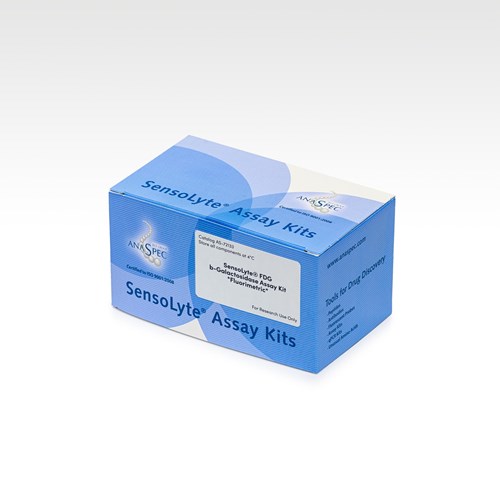
SensoLyte® FDG ß-Galactosidase Assay Kit Fluorimetric - 1 kit
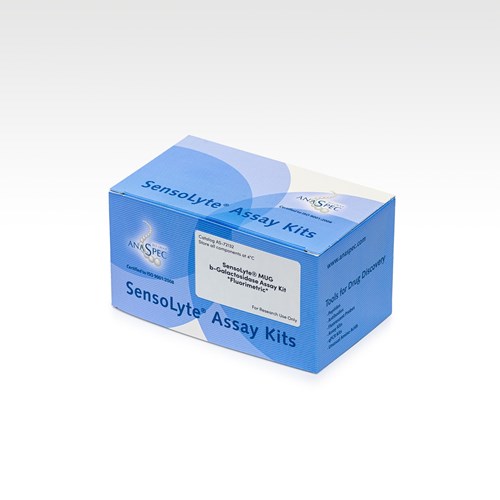
SensoLyte® MUG ß-Galactosidase Assay Kit Fluorimetric - 1 kit
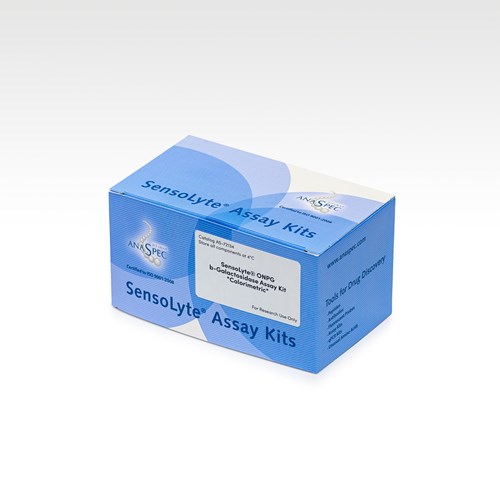
SensoLyte® ONPG ß-Galactosidase Assay Kit Colorimetric - 1 kit
Citations
Common Origins of Hippocampal Ivy and Nitric Oxide Synthase Expressing Neurogliaform Cells.
J Neurosci . 2010 Feb 10 ; 30(6) 2165 | DOI : 10.1523/JNEUROSCI.5123-09.2010.
- L. Tricoire
References
A fluorimetric method using fluorescein di-β-d-galactopyranoside for quantifying the senescence-associated β-galactosidase activity in human foreskin fibroblast Hs68 cells.
Anal Biochem . 2004 Feb 15 ; 325(2) 337 | DOI : https://doi.org/10.1016/j.ab.2003.11.012
- NC. Yang
- ML. Hu
Detection of β-lactamase reporter gene expression by flow cytometry
Cytometry . 2003 Feb 01 ; 51A(2) 68 | DOI : https://doi.org/10.1002/cyto.a.10018
- T. Knapp
- et al
Flow cytometric study of differentiating cultures of Bacillus subtilis
Cytometry . 1995 Aug 01 ; 20(4) 324 | DOI : https://doi.org/10.1002/cyto.990200408
- JD. Chung
- et al
Involvement of macrophage mannose receptor in the binding and transmission of HIV by macrophages
Eur J Immunol . 2003 Feb 01 ; 33(2) 483 | DOI : https://doi.org/10.1002/immu.200310024
- DG. Nguyen
- JE. Hildreth
Verapamil inhibition of enzymatic product efflux leads to improved detection of β-galactosidase activity in lacZ-transfected cells
Cytometry . 1997 May 01 ; 28(1) 36 | DOI : https://doi.org/10.1002/(SICI)1097-0320(19970501)28:1<36::AID-CYTO4>3.0.CO;2-F
- M. Poot
- S. Arttamanglul
Reliable Transient Promoter Assay Using Fluorescein-di-β-D-galactopyranoside Substrate
DNA Cell Biol . 2009 Mar 25 ; 9(4) 279 | DOI : https://doi.org/10.1089/dna.1990.9.279
- K. Ikenaka
- et al