
SensoLyte® 520 HCV Protease Assay Kit Fluorimetric - 1 kit
- Cat.Number : AS-71145
- Manufacturer Ref. :
-
Availability :
In stock
- Shipping conditions : Ice fees will apply
Alternative choices

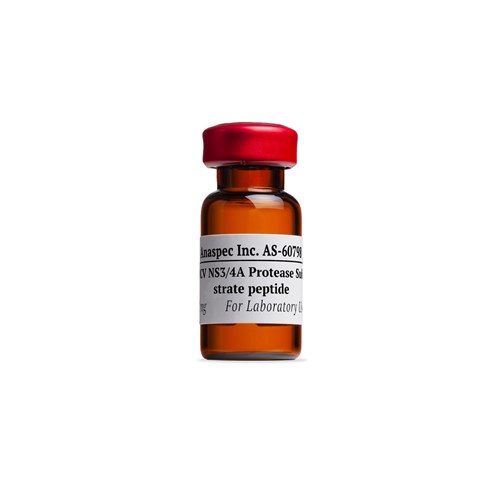
The SensoLyte® 520 HCV Assay Kit uses a new FRET peptide substrate that incorporates 5-FAM (fluorophore) and QXL™ 520 (quencher) for a continuous measurement of enzyme activities. In the intact FRET peptide, the fluorescence of 5-FAM is quenched by QXL™ 520. Upon cleavage of the FRET peptide by HCV NS3/4a protease, the fluorescence of 5-FAM is recovered and can be continuously monitored at excitation/emission = 490 nm/520 nm. With superior fluorescence quantum yield and longer emission wavelength, this 5-FAM/QXL™ 520-based FRET peptide shows less interference from autofluorescence of test compounds and cellular components. This assay is ten times more sensitive than an EDANS/DABCYL based assay and can detect 0.1 pmole of HCV NS3/4a protease. The assays are performed in a convenient 96-well or 384-well microplate format.
Specifications
| Packaging | |
| Kits components |
|
|---|---|
| Properties | |
| Absorbance (nm) |
|
| Emission (nm) |
|
| Storage & stability | |
| Storage Conditions |
|
| Activity | |
| Application | |
| Biomarker Target | |
| Detection Method | |
| Detection Limit |
|
| Research Area | |
| Sub-category Research Area | |
| Usage |
|
Downloads
You may also be interested in the following product(s)


Citations
Piperazine-derived small molecules as potential Flaviviridae NS3 protease inhibitors. In vitro antiviral activity evaluation against Zika and Dengue viruses
Bioorg Chem . 2023 Feb 04 ; 133 106408 | DOI : https://doi.org/10.1016/j.bioorg.2023.106408
- M. del Rosario García-Lozano
- et al
Development of a rapid phenotypic test for HCV protease inhibitors with potential use in clinical decisions
Genet Mol Biol. . 2016 Jul 01 ; 39(3) 358 | DOI : 10.1590/1678-4685-GMB-2016-0022
- L. Pessoa
Identification and biochemical characterization of Halisulfate 3 and Suvanine as novel inhibitors of Hepatitis C Virus NS3 Helicase from a marine sponge
Mar Drugs . 2014 Jan 21 ; 12(1) 462 | DOI : 10.3390/md12010462
- A. Furuta
Potent and selective inhibition of hepatitis C virus replication by novel phenanthridinone derivatives
Biochem Biophys Res Commun . 2011 Nov 09 ; 415(4) 714 | DOI : 10.1016/j.bbrc.2011.10.153
- M.T.A. Salim
HCV-NS3/4A Protease inhibitory iridoid glucosides and dimeric foliamenthoic ccid derivatives from Anarrhinum orientale
J Nat Prod . 2011 Apr 20 ; 74(5) 943 | DOI : 10.1021/np100554h
- R. Dine
Design, asymmetric synthesis, and evaluation of pseudosymmetric sulfoximine inhibitors against HIV-1 protease
J BMC . 2010 Mar 01 ; 18(5) 2037 | DOI : https://doi.org/10.1016/j.bmc.2010.01.020
- D. Lu
Bioactivity-guided screening identifies pheophytin a as a potent anti-hepatitis C virus compound from Lonicera hypoglauca Miq
Biochem Biophys Res Commun . 2009 May 19 ; 385(2) 230 | DOI : 10.1016/j.bbrc.2009.05.043
- S-Y. Wang
Inhibitory effects of antrodins A-E from Antrodia cinnamomea and their metabolites on hepatitis C virus protease
Phytother Res. . 2009 Apr 01 ; 23(4) 582 | DOI : 10.1002/ptr.2657
- D.T. Phuong
Synthesis of dammarane-type triterpene derivatives and their ability to inhibit HIV and HCV proteases
Bioorg Med Chem . 2009 Mar 14 ; 17(8) 3003 | DOI : 10.1016/j.bmc.2009.03.019
- Y. Wei
HCV Protease Inhibitory, Cytotoxic and Apoptosis-Inducing Effects of Oleanolic Acid Derivatives
J Pharm Pharm Sci. . 2009 Jan 01 ; 12(3) 243 | DOI : 10.18433/j3dw2d
- C. Ma
Triterpenes from Cynomorium songaricium--analysis of HCV protease inhibitory activity, quantification, and content change under the influence of heating.
J Nat Med . 2008 Jul 04 ; 63(1) 9 | DOI : 10.1007/s11418-008-0267-7
- C. Ma
NS3 helicase domains involved in infectious intracellular Hepatitis C Virus particle assembly
J Virol. . 2008 May 28 ; 82(15) 7624 | DOI : 10.1128/JVI.00724-08
- Y. Ma