
[Pyr3]-beta-Amyloid (3-40)
- Cat.Number : AS-29906-01
- Manufacturer Ref. :
-
Availability :
In stock
Alternative choices

A hallmark of Alzheimer's disease (AD) is the presence of beta-Amyloid in plaques in the brains of patients. N-terminally truncated pyroglutamate-modified beta-Amyloid forms such as Aß(3-40) and Aß (11- 40) have been described as major compounds in the senile plaques. Pyro-Glu modified beta-Amyloid forms are more resistant to degradation, show higher toxicity and have increased aggregation propensity compared to non-modified beta-Amyloid.
Specifications
| Chemistry | |
| Sequence one letter code |
|
|---|---|
| Sequence three letter code |
|
| CAS registry number |
|
| Molecular Formula |
|
| Molecular Mass/ Weight |
|
| Modification | |
| Conjugation |
|
| Quantity & Purity | |
| Purity |
|
| Storage & stability | |
| Form |
|
| Storage Conditions |
|
| Activity | |
| Biomarker Target | |
| Research Area | |
| Sub-category Research Area | |
| Usage |
|
| Source | |
| Source / Species |
|
Downloads
You may also be interested in the following product(s)
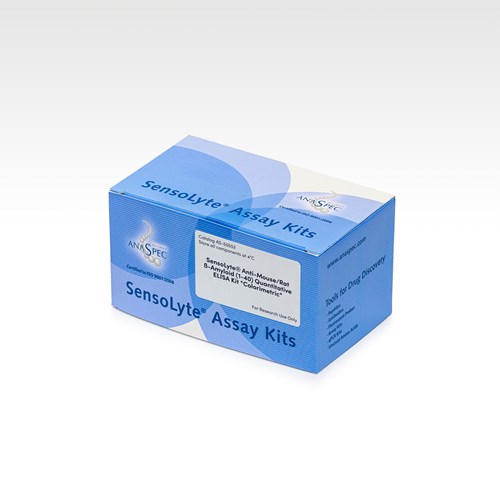
SensoLyte® Anti-Mouse/Rat ß-Amyloid (1-40) Quantitative ELISA Kit Colorimetric - 1 kit
References
Aβ peptides and calcium influence secretion of the amyloid protein precursor from chick sympathetic neurons in culture
J Neurosci Res . 2000 Aug 15 ; 61(4) 449 | DOI : https://doi.org/10.1002/1097-4547(20000815)61:4<449::AID-JNR12>3.0.CO;2-N
- SS. Mok
- et al
Presenilin-1 mutations in Alzheimer's disease
Neurobiol Nature . 2000 Jun 01 ; 405 531 | DOI : https://doi.org/10.1038/35014735
- C. Russo
- et al