Chelating Peptides for Radiopharmaceuticals in Theranostic Oncology

Peptide-based radiopharmaceutical therapy (RPT), using chelating peptides to deliver radioisotopes directly to tumor sites, is revolutionizing oncology by offering a more precise, minimally invasive approach to radiation therapy, giving new hope for patients with treatment-resistant cancers.
For over a century, external beam radiation therapy (EBRT) has remained a cornerstone of cancer treatment.1 The earliest form introduced in 1896, used low energy radiation from X-rays generated by cathode ray tubes. The discovery of radioactivity in uranium by Henri Becquerel, followed by the identification of polonium and radium by Marie and Pierre Curie, led to a turning point in 1936, when the first radionuclide was used in EBRT to treat cancer.2
EBRT today uses linear accelerators (LINACs) to generate high-energy x-rays or electrons and remains a standard treatment for many cancer types. However, it does not fully distinguish between cancerous and healthy cells, sometimes resulting in harmful unintended radiation exposure to normal tissue.
The Rise of Targeted Radiopharmaceutical Therapy (RPT)
In the pursuit of safer and more effective radiation therapy, advancements in nuclear medicine have sparked a paradigm shift in oncology: radiopharmaceutical therapy (RPT), also known as targeted radionuclide therapy (TRT). This approach introduces the concept of theranostics or more specifically radiotheranostics, where diagnostic imaging and therapeutic intervention are integrated into a single platform.2,3
Within this modality, a targeting vector is used to precisely deliver the radionuclide payload directly to diseased tissue, minimizing damage to healthy cells. Peptide-based targeting vectors, are particularly advantageous as they can be designed to bind tumor-associated receptors, a strategy exemplified in peptide receptor radionuclide therapy (PRRT). Beyond receptor targeting, peptides can be modified to interact with the tumor microenvironment or other disease-specific markers, expanding their potential in precision oncology.
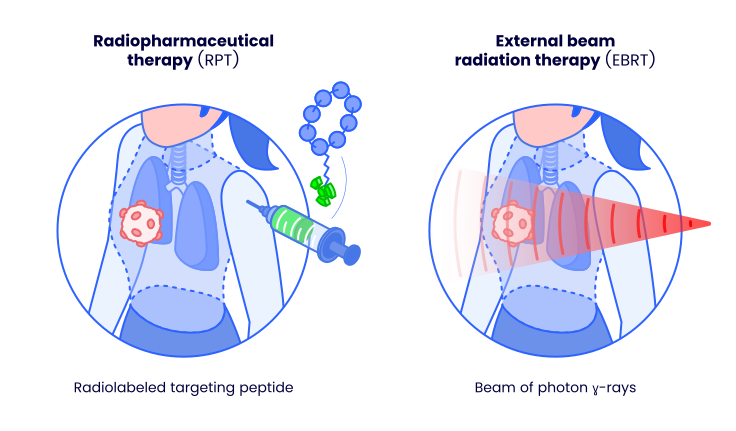
To enable precise radionuclide delivery, the targeting peptide is conjugated to a chelating agent (chelator) that binds radiometals. This chelating peptide is then complexed via its chelator to a “matched pair” of radionuclides, one emitting gamma rays for imaging purposes and a second that emits particles effective in therapy. In doing so, the peptide can be adapted for either diagnostic or therapeutic application (theranostics).4 These radionuclide pairs may consist of the same element (true-matched pairs), which are rare (61/64Cu/67Cu, 203Pb/212Pb or 123/124I/131I) or from different elements with similar chemical properties (99mTc/186/188Re, 68Ga/177Lu or 68Ga/225Ac).5
Advantages of Radiotheranostics with Chelator-Conjugated Peptides
Targeted Delivery
Administered intravenously, RPT agents in oncology are designed to bind specifically to tumor cells, delivering a localized dose of radiation while sparing healthy tissues for improved safety. This minimizes off-target toxicity, a common drawback of EBRT where high energy photons or electrons must pass through healthy tissues to reach the tumor. Peptide Receptor Radionuclide Therapy (PRRT) is a common approach for cancers with overexpression of specific receptors on tumor cells3,6.
Higher Potency
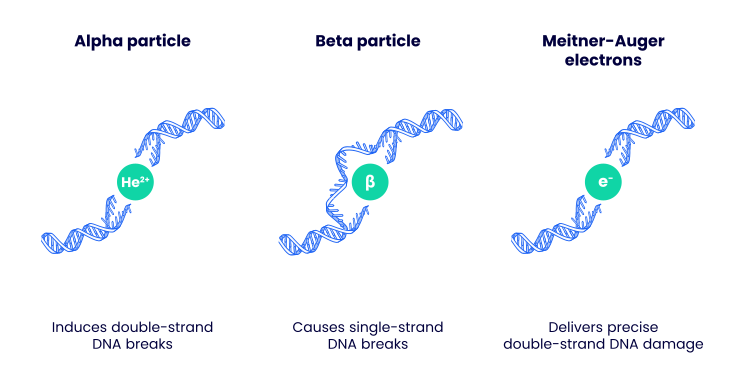
Therapeutic radionuclides used in RPT can be categorized by the type of particles they emit from the nucleus upon decay. Each type of emission results in cell death through direct damage of cellular DNA and organelles and indirect damage through production of destructive radical oxygen species (ROS).7
α-Particles
- Alpha-emitting radionuclides release helium particles (He2+) during decay—having high energy and a very short range in tissue. Their concentrated energy deposition makes them especially effective at inducing double-strand DNA breaks, a form of damage that is far more difficult for cancer cells to repair than single-stranded breaks. This often results in permanent and lethal effects on the tumor.
β-Particles
- Beta-emitting radionuclides release two types of beta-particles: negatively charged electrons and positively charged electrons. The negatively charged beta-particles used in therapy, cause single-strand DNA breaks. While less damaging per interaction than alpha emitters, these negatively charged beta particles can cover a larger area, which is advantageous for treating larger tumors or those with micrometastases.4 Beta-emitters also release positively charged electrons called positrons that are used in PET imaging.
Auger e⁻
- Meitner-Auger electrons are a secondary effect of nuclear decay and are emitted from the inner atomic shell (ie., K-shell) of the electron cloud, rather than the nucleus. These particles have an extremely short-range and when deliverd into the cell nucleus, offer the potential for precise double-stranded DNA damage, and hence are under investigation for RPT.8
Precise Imaging
Radionuclides used in theranostic imaging emit high-energy photons (gamma radiation). These photons are directly emitted from the radionuclide in the case of Single Photon Emission Computed Tomography (SPECT) or indirectly through positron annihilation in the case of Positron Emission Tomography (PET)6, which are vital for tracking the distribution and tumor uptake of RPT agents.
SPECT is most commonly used for routine diagnostic applications, while PET often the choice in RPT, offers superior spatial resolution and can enable tumor visualization before, during, and after treatment.4 When combined with computed tomography (CT), PET scans offer enhanced visualization of both tumor activity and anatomical structures for more precise analysis and better informed decision-making.1
Stages of Visualization
- Pre-treatment: Identify patients most likely to respond to RPT
- During treatment: Visualize tumors in real-time offering unparalleled precision
- Post-treatment: Monitor treatment efficacy through follow-up imaging
Therapeutic vs Imaging Particles in RPT6
Comparison of particle types used in RPT for therapy vs diagnostics. Note: most radionuclides emit more than one particle type.
|
Particle Type |
Application |
Radionuclide Examples |
|
Alpha (α) |
Therapeutic |
223Ra, 225Ac |
|
Beta (β-) |
Therapeutic |
131I, 90Y |
|
Gamma (ɣ) |
SPECT |
61Cu, 99mTc |
|
Positron (β+) |
PET |
68Ga |
Chelating Peptides
In PRRT (Peptide Receptor Radionuclide Therapy), the chelating peptide, is the precursor or starting material of the radiopharmaceutical therapeutic. It is composed of three (3) main parts:
- Targeting peptide
- Linker
- Chelator2
Together, these components enable precise delivery of a radioactive payload to tumor cells. Linkers are often used, but not in all cases.
Peptides: Optimal Targeting Moieties
A critical step in RPT development is the identification of tumor- or tumor microenvironment-associated molecules as potential targets. Peptides are increasingly used as targeting agents in RPT due to their unique biochemical properties:
- High Specificity: Peptides can be designed to enhance biding selectively to receptors overexpressed in tumors, such as somatostatin receptors in neuroendocrine tumors or gastrin-releasing peptide receptors in prostate cancer.
- Favorable Pharmacokinetics: Their small size and hydrophilic nature allow rapid clearance from non-target tissues, reducing systemic toxicity.
- Design Flexibility: Synthetic peptides can be chemically modified to change their structure or enhance their properties through incorporation of unnatural amino acids, for improved stability and receptor-binding affinity.
Discovery of high-affinity peptide ligands typically involves peptide libraries, phage display, and rational design strategies. However, achieving the right balance between hydrophilicity and lipophilicity is critical. Overly hydrophilic peptides may show poor tumor retention, while excessive lipophilicity can lead to undesirable kidney uptake, increasing the risk of renal toxicity.2 Linker strategies and charge modifications can help mitigate this effect.
Chelating Agents & Linkers
Chelators used in radiopharmaceuticals must be bifunctional, meaning they contain two functional domains:
- Chelation domain: forms a strong, stable complex with the radionuclide.
- Conjugation domain: covalently binds the targeting peptide vector (directly or via a linker) through a reactive group such as a primary amine, carboxylic acid, or isothiocyanate. More than one conjugation domain may exist.
This dual functionality enables precise delivery of the radioactive payload to the intended biological target while minimizing off-target release.
DOTA (1,4,7,10-tetraazacyclododecane-1,4,7,10-tetraacetic acid) is considered a gold standard in theranostic applications.⁶˒¹⁰ However, depending on the specific combination of targeting vector, linker, and radionuclide, other chelators such as NOTA, NODAGA, etc, may offer greater suitability.
Choosing a Chelator
- High Stability: A chelator must form a highly stable complex with the radiometal of choice, ensuring that the radioactive isotope remains attached to the targeting molecule to prevent premature release in the body. Ideally, the chelator can be complexed with the radionuclide, under mild labeling conditions, and does not interfere with the peptide targeting function.
- Versatility: The chelator must complex with both diagnostic and therapeutic radiometals, such as gallium-68 (PET imaging), lutetium-177 (therapy), and yttrium-90 (therapy), enabling the same precursor molecule to serve dual purposes.
- Radiochemical Efficiency: High radiochemical yields are ideal for radiolabeling even small peptide quantities, simplifying kit-based production for clinical use.11
Linkers often used in chelating peptides serve several functions. They are used as spacers to reduce steric hindrance between the radionuclide and receptor binding site (ie., β-alanine, aminohexanoic acid (Ahx)), or used to optimize pharmacokinetics by increasing hydrophilicity and reduce renal uptake (ie., PEG2-PEG12).6
FDA Approved Theranostic Peptides
The theranostic approach has significantly accelerated drug development timelines as it leverages diagnostic imaging to identify patients who express the therapeutic target. This provides invaluable insights into biodistribution, pharmacokinetics, and tumor targeting in a clinical setting.
Below are some examples of peptide-based radiopharmaceuticals that have achieved clinical success:
- Lutetium-177-DOTATATE (Lutathera): Targets somatostatin receptors. Approved in 2018 for neuroendocrine tumors.
- Gallium-68 PSMA-11: Used for imaging prostate-specific membrane antigen in prostate cancer.
- Lutetium-177-PSMA-617 (Pluvicto): A therapeutic counterpart to Gallium-68 PSMA-11, delivering cytotoxic radiation to prostate tumors approved in 2023.2
The Future of Chelating Peptides in RPT
The versatility of chelating peptides, coupled with advancements in radiometal chemistry, continues to drive innovation in theranostics. Emerging strategies such as foldamer design—which stabilizes peptide conformations using non-natural amino acids—are expanding the toolkit for developing high-affinity, stable targeting agents. Moreover, the development of new bifunctional chelating agents (BFCAs) aims to improve biodistribution and reduce off-target effects further.10
Conclusion
Chelating peptides for radiopharmaceuticals represent a transformative approach in oncology, bridging diagnostics and therapy to deliver precision medicine. By leveraging advancements in peptide engineering and radiometal chelation, RPT offers a safer, more effective alternative to traditional radiation therapy. Ongoing research promises to make future cancer care even more personalized and precise.
R&D to GMP Grade Manufacturing - Chelating Peptides
With over 30 years of peptide manufacturing expertise, AnaSpec specializes in the custom production of chelating peptides designed to meet your exact specifications. We seamlessly integrate your targeting peptide sequence with the linker and metal-binding chelating agent of your choice for radiopharmaceutical and diagnostic applications.
 |
Chelating Peptide CDMO - Key Factors
|
Our capabilities include both linear and cyclic peptide manufacturing, achieved through diverse cyclization strategies such as lactam-ring formation, thioether bridging, disulfide bridging, and other linkage types. We also incorporate unusual amino acid modifications to enhance stability, binding affinity and bioavailability. For reference standards, we provide cold non-radiometal-conjugated peptides to support analytical workflows.
From research-grade to GMP-grade production, we deliver batches from milligram to multi-100-gram scale, with purities up to 95% for research applications and 98% for cleanroom GMP manufactured clinical materials, API starting materials, and API precursors.
Our portfolio of linkers and chelators includes DOTA, NOTA, and many others, and we welcome projects using your proprietary chelators. Backed by a commitment to innovation, quality, reliability, and security, AnaSpec provides custom chelating peptide solutions tailored to the evolving needs of modern research and healthcare.
Frequently Asked Questions
Q: What’s the difference between EBRT and RPT?
A: EBRT directs external high-energy beams at tumors, while RPT uses targeted molecules to deliver radioactive isotopes directly to cancer cells, minimizing exposure to healthy tissue.
Q: Does AnaSpec provide radiolabeling services?
A: No, AnaSpec supplies the custom peptide-chelator precursors — radiolabeling is performed by authorized radiopharmacies or nuclear medicine facilities.
Q: What chelators can AnaSpec conjugate to peptides?
A: We offer popular chelators such as DOTA, NOTA, and others upon request or you may supply your own chelating agent.
References
- Sharma, S. & Pandey, M. K. Radiometals in Imaging and Therapy: Highlighting Two Decades of Research. Pharmaceuticals 16, 1460 (2023).
- Zhang, S. et al. Radiopharmaceuticals and their applications in medicine. Signal Transduct. Target. Ther. 10, 1 (2025).
- Merola, E. & Grana, C. M. Peptide Receptor Radionuclide Therapy (PRRT): Innovations and Improvements. Cancers 15, 2975 (2023).
- Morgan, K. Advances in Inorganic Chemistry ‘Chapter Two - Metallic Radionuclides for Diagnostic Imaging and Cancer Radiotherapy: The Development of Theragnostic Matched Pairs and Targeted Alpha Therapy’. vol. 78 (Academic Press, Cambridge, MA USA, 2021).
- Kronke, T. Enhancing the radionuclide theranostic concept through the radiohybrid approach. R. Soc. Chem. 16, 1856–1864 (2024).
- Holik, H. A. et al. The Chemical Scaffold of Theranostic Radiopharmaceuticals: Radionuclide, Bifunctional Chelator, and Pharmacokinetics Modifying Linker. Molecules 27, 3062 (2022).
- Salernao, K. A Primer on Radiopharmaceutical Therapy. Int. J. Radiat. Oncol. Biol. Phys. 115, 48–59 (2023).
- Ku, A., Facca, V. J., Cai, Z. & Reilly, R. M. Auger electrons for cancer therapy – a review. EJNMMI Radiopharm. Chem. 4, 27 (2019).
- Moyaert, P. PET vs SPECT | The basics [Video]. YouTube https://www.youtube.com/watch?v=_NSyAEi12M0 (2022).
- Sneddon, D. & Cornelissen Bart. Emerging chelators for nuclear imaging. Curr. Opin. Chem. Biol. 63, 152–162 (2021).
- Baranyai, Z., Tircsó, G. & Rösch, F. The Use of the Macrocyclic Chelator DOTA in Radiochemical Separations. Eur. J. Inorg. Chem. 2020, 36–56 (2020).