Cyclic Peptides: Structure, Uses, and Advantages

Cyclic peptides are reshaping drug development and research, offering unique advantages over their linear counterparts. This article explores the diverse linkages that create these constrained peptides, their size variations, and how they are being applied to advance drug discovery and development.
Peptides are indispensable in biomedical research, drug discovery, diagnostics and beyond. Among them, cyclic peptides stand out for their broad therapeutic potential, due to their distinctive structural properties, providing improved structural resilience and precise target specificity. Development of cyclic peptide-based drugs is therefore on the rise.
What Are Cyclic Peptides?
Cyclic peptides, are characterized by their amino acid sequences forming one or more covalently bonded ring structures. Naturally occurring cyclic peptides, such as hormones, play key roles in cell signaling, to control critical biological functions. The first cyclic peptides to be developed as hormone drugs were oxytocin and vasopressin, introduced into clinical use in the 1960s.1
Cyclic peptides can also be synthetically manufactured using solid-phase and liquid-phase synthesis techniques. This allows the incorporation of non-canonical amino acids and special building blocks, providing greater design flexibility. Synthetic cyclization is also used to constrain the secondary structures of linear peptides, improving their properties.
Often better suited than their linear counterparts in therapeutic applications2, cyclic peptides offer superior pharmacokinetic properties3 due to:
- Enhanced stability: Resistance to enzymatic degradation and improved structural integrity.
- Improved target specificity and binding affinity: Enhanced interactions with proteins, nucleic acids, and other biomolecules.
- Increased bioavailability: Improved cell permeability and ability to reach bloodstream.
One notable advantage of cyclic peptides is their ability to inhibit protein–protein interactions, which are typically difficult to target in drug discovery.4
Cyclic peptides are constrained using various linkage types, each with their own design advantages, including Lactam rings, Disulfide bridges, Hydrocarbon staples, Thioether bridges, and Thiolactone bridges.
1. Lactam ring cyclic peptides
Lactam ring peptides are formed through amide bond linkages between amino acid side-chains, and/or the terminal ends of the peptide sequence, creating rigid cyclic structures. Lactam ring peptides are widely used in drug discovery, particularly in protein–protein interaction (PPI) inhibitors, antimicrobial drug design, and peptide-based therapeutics. The presence of beta-lactam rings in antibiotics like penicillin demonstrates the medical importance of this cyclization strategy.
Types of lactam ring cyclizations2,5
- Head-to-tail cyclization: The N-terminal amine and C-terminal carboxyl group form a closed lactam ring, stabilizing the peptide structure and increasing metabolic resistance.5
- Head-to-side chain cyclization: A side-chain carboxyl group (typically from aspartic acid or glutamic acid) forms a lactam bridge with the N-terminal amine, restricting flexibility and enhancing target engagement.5
- Tail-to-side chain cyclization: The C-terminal carboxyl group links to a side-chain amine (such as from lysine), increasing stability and altering binding dynamics.5
- Side-chain-to-side-chain cyclization: Two side-chain functional groups (e.g., amine and carboxyl groups) form an amide bond, leading to increased conformational constraint and enhanced receptor binding affinity.5
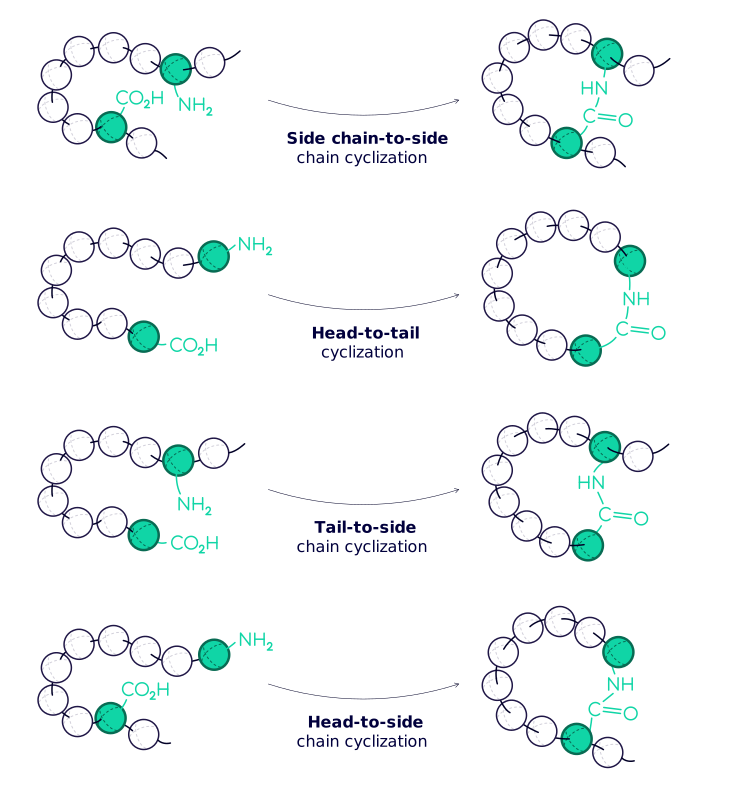
Schematic illustration of Lactam ring cyclization :
side chain-to-side chain, head to tail, tail-to-side chain and head-to-side chain.
2. Disulfide Bridges (S–S Bond Cyclization)
Disulfide bridges are covalent bonds formed between the thiol (-SH) groups of cysteine residues. These bridges can be intramolecular, linking two cysteines within the same peptide, or intermolecular, forming bonds between separate peptide molecules. Their formation plays a key role in peptide folding, structural stability, and biological activity.4
The number of disulfide bonds within a peptide influences structural rigidity and enzymatic resistance. Peptides with multiple disulfide bridges can adopt complex tertiary structures, contributing to their structural integrity and bioactivity.2

Schematic illustration of a disulfide-bridged peptide.
Disulfide bridges also contribute to stabilizing α-helical secondary structure formation6, and helping peptides maintain their biologically active form. Their presence reduces flexibility and improves binding affinity to target molecules. However, while disulfide bonds enhance stability, they can be susceptible to reduction in biological environments. To overcome this, more stable analogs such as lactam, thioether, selenium, triazole, or dicarba bridges have been developed.
Disulfide-bridged peptides are widely found in toxins, hormones, and therapeutic peptides due to their natural occurrence and bioactivity.
Hydrocarbon-Stapled Peptides
Hydrocarbon-stapled peptides are a class of cyclic peptides that incorporate synthetic hydrocarbon linkages to reinforce their α-helical structures, improving stability, protease resistance, and membrane permeability. This cyclization method enhances binding affinity and enables peptides to target intracellular pathways, making them highly valuable in drug development.2
Stapled peptides are particularly valuable in intracellular drug targets, including cancer therapeutics.

Schematic illustration of an hydrocarbon-stapled peptide.
Hydrocarbon staples, which are analogs of N-methyl alanine, are positioned at defined intervals along the peptide chain.
- i & i+3 stapling: Creates a short-range constraint, preserving local secondary structure.
- i & i+4 stapling: Provides moderate stability while maintaining flexibility.
- i & i+7 stapling: Reinforces long-range helical conformation for better cellular uptake.
Thioether-Bridged Peptides
Thioether-bridged peptides are cyclic peptides stabilized by a sulfur-based linkage, offering superior stability compared to amide and disulfide bonds. This modification prevents enzymatic degradation and increases resistance to reduction, overcoming a key limitation of disulfide bridges.7

Schematic illustration of a thioether-bridged peptide.
Their enhanced stability and selectivity make them promising candidates for enzyme-resistant peptide drugs, including antimicrobial peptides, hormonal therapies, and neuropeptides. Thioether-bridged peptides are being actively explored in drug development for targeted receptor modulation and improved bioavailability.
Thiolactone-Cyclized Peptides
Thiolactone-cyclized peptides are a class of cyclic peptides in which a thiol group within the peptide reacts with a carboxyl group, forming a thioester bond. This modification strengthens the peptide’s resistance to enzymatic degradation and improves conformational integrity, making these peptides attractive for therapeutic applications.

Schematic illustration of a thiolactone-cyclized peptide.
Recent advances in synthetic methods have improved the efficiency of thiolactone cyclization, allowing the formation of macrocyclic and medium-sized thiolactones. These larger rings offer flexibility in peptide design, providing new opportunities for drug development and biological applications.8
Thiolactone-cyclized peptides are being explored for peptide-based therapeutics, including targeted drug delivery and enzyme-resistant peptide drugs. A specific class of macrocyclic thiolactones which are analogs of autoinducing peptides (AIPs), has been successfully investigated for their antibacterial properties as modulators of the quorum sensing system to attenuate and treat S. aureus infections.9
Comparison of key cyclic peptide types, their advantages, and applications
| Cyclic Peptide Type | Key Advantages | Some Applications |
|
Lactam Ring Peptides |
|
|
|
Disulfide-Bridged Peptides |
|
|
|
Stapled Peptides |
|
|
|
Thioether-Bridged Peptides |
|
|
|
Thiolactone-Cyclized Peptides |
|
|
Cyclic Peptide Cell-Permeability
Currently, most approved cyclic peptide drugs are administered by injection, due to limited cell permeability, which restricts them to targeting extracellular molecules. However, not all cyclic peptides share this limitation. Some small cyclic peptides, typically those containing 10 or fewer amino acids and weighing under 1 kDa, can exhibit membrane permeability and oral bioavailability. These properties make them well-suited for targeting intracellular protein-protein interactions and developing therapeutic agents, such as enzyme inhibitors. Notably, small cell-permeable cyclic peptides are gaining attention for their potential to address difficult intracellular targets that traditional small molecules struggle to modulate.1
In contrast, larger cyclic peptides, those exceeding 10 amino acids, tend to have low membrane permeability, often requiring structural modifications to enhance their pharmacokinetics. These non-permeable peptides, generally more polar and larger than 1 kDa, are primarily designed to bind extracellular targets, such as surface receptors. A significant opportunity for large cyclic peptides lies in the development of high-affinity ligands for tumor markers, which can be leveraged for imaging or the targeted delivery of cytotoxic drugs. Their favorable tissue penetration and relatively fast renal clearance enable selective accumulation at target sites, enhancing their therapeutic potential.1
Key Applications of Cyclic Peptides in Drug Discovery and Biotechnology
Therapeutics and Drug Discovery
Cyclic peptides are key players in drug development, offering high specificity in targeting biological molecules. Their stability and enzymatic resistance make them promising candidates for treating diseases such as cancer, metabolic disorders, and infections.10
Fewer Side Effects Compared to Small Molecules
One major advantage of cyclic peptides over small-molecule drugs is their lower risk of off-target interactions. Small molecules can bind multiple unintended biological targets, leading to adverse side effects. In contrast, cyclic peptides exhibit higher specificity, reducing interactions with non-target proteins and minimizing toxicity.10
Additionally, cyclic peptides naturally degrade into non-toxic amino acids, lowering the risk of drug accumulation and systemic toxicity. Their structural rigidity further enhances safety, ensuring that they bind only to their intended targets. These properties make cyclic peptides particularly valuable in precision medicine, where reducing unintended side effects is a priority.
Research and High-Throughput Screening
Cyclic peptides play a crucial role in biochemical research, particularly in assay development, peptide libraries, and high-throughput screening (HTS) experiments. Their rigid structures enhance binding specificity and stability, making them ideal for drug discovery platforms.
- In fluorescence resonance energy transfer (FRET) assays, cyclic peptides serve as probes for studying molecular interactions, providing accurate and reproducible results. 11
- Competitive fluorescence-based screening assays have been developed to identify dimeric cyclic peptides that selectively bind ubiquitin chains, offering new opportunities in drug discovery.11
Diagnostics
While linear peptides dominate diagnostic applications, some cyclic peptides with engineered protein-binding properties have been explored for biomarker detection and molecular recognition assays.12 Their high affinity and specificity make them valuable for specialized applications, though their use in routine diagnostics is still emerging.
Conclusion
Cyclic peptides represent a versatile and innovative class of biomolecules, with applications in research to therapeutics and diagnostics. Their stability, specificity, and adaptability make them essential tools in modern drug discovery.
By incorporating advanced cyclization techniques such as thioether bridges, researchers can enhance oral bioavailability, addressing one of the most significant challenges in peptide-based drug development.
At AnaSpec, we provide custom cyclic peptide synthesis solutions, helping scientists and biotech companies advance their research and therapeutic innovations with precision and efficiency.
Custom Cyclic Peptide Manufacturing at AnaSpec
With over 30 years of expertise, AnaSpec is a trusted leader in peptide manufacturing, specializing in custom cyclic peptide synthesis for research and therapeutic applications. Our experience spans simple sequences to highly complex, modified peptides, ensuring we meet the unique needs of our customers with flexibility and precision.
Our state-of-the-art facilities enable the production of high-quality cyclic peptides, including:
- Lactam Ring Peptides
- Stapled Peptides
- Disulfide-Bridged Peptides
- Thioether-Bridged Peptides
- Thiolactone-Cyclized Peptides
From research-grade to GMP-compliant manufacturing, we provide tailored solutions that support scientific innovation and drug development. While linear peptides remain dominant in diagnostics and cosmetics, cyclic peptides offer advantages in stability and specificity, making them suitable for specialized applications in these fields.
At AnaSpec, we are committed to delivering high-purity, customized cyclic peptides, helping researchers and pharmaceutical innovators advance their projects.
FAQs about Cyclic Peptides
Q: What are the main benefits of cyclic peptides over linear peptides?
A: They have higher stability, resistance to enzymes, improved specificity, and can modulate difficult protein–protein interactions.
Q: Are cyclic peptides orally bioavailable?
A: Some small cyclic peptides are — for larger ones, special design strategies are used to enhance absorption.
Q: What cyclic peptide types can AnaSpec synthesize?
A: We offer lactam ring, disulfide-bridged, stapled, thioether-bridged, and thiolactone-cyclized peptides, fully customized to your project.
Q: Does AnaSpec provide GMP-grade cyclic peptides?
A: Yes — we manufacture both research-grade and GMP-compliant peptides for clinical development.
Q: How can I request a custom cyclic peptide?
A: Simply contact our team with your sequence and requirements — we’ll deliver a tailored solution.
References
- Berichtigung: Cyclic Peptides for Drug Development. Angewandte Chemie 136, e202319807 (2024).
- Choi, J.-S. & Joo, S. H. Recent Trends in Cyclic Peptides as Therapeutic Agents and Biochemical Tools. Biomolecules & Therapeutics 28, 18–24 (2020).
- Zhang, H. & Chen, S. Cyclic peptide drugs approved in the last two decades (2001–2021). RSC Chem. Biol. 3, 18–31 (2022).
- Bechtler, C. & Lamers, C. Macrocyclization strategies for cyclic peptides and peptidomimetics. RSC Med. Chem. 12, 1325–1351 (2021).
- Hayes, H. C., Luk, L. Y. P. & Tsai, Y.-H. Approaches for peptide and protein cyclisation. Org. Biomol. Chem. 19, 3983–4001 (2021).
- Gray, W. R. Disulfide structures of highly bridged peptides: A new strategy for analysis. Protein Science 2, 1732–1748 (1993).
- Bosma, T. et al. Bacterial Display and Screening of Posttranslationally Thioether-Stabilized Peptides. Appl Environ Microbiol 77, 6794–6801 (2011).
- Palate, K. Y., Epton, R. G., Whitwood, A. C., Lynam, J. M. & Unsworth, W. P. Synthesis of macrocyclic and medium-sized ring thiolactones via the ring expansion of lactams. Org. Biomol. Chem. 19, 1404–1411 (2021).
- Benny, A. & Scanlan, E. M. Synthesis of macrocyclic thiolactone peptides via photochemical intramolecular radical acyl thiol–ene ligation.
- Zhang, H. & Chen, S. Cyclic peptide drugs approved in the last two decades (2001–2021). RSC Chem. Biol. 3, 18–31 (2022).
- Vamisetti, G. B., Meledin, R., Nawatha, M., Suga, H. & Brik, A. The Development of a Fluorescence‐Based Competitive Assay Enabled the Discovery of Dimeric Cyclic Peptide Modulators of Ubiquitin Chains. Angew Chem Int Ed 60, 7018–7023 (2021).
- Song, Y., Madahar, V. & Liao, J. Development of FRET Assay into Quantitative and High-throughput Screening Technology Platforms for Protein–Protein Interactions. Ann Biomed Eng 39, 1224–1234 (2011).